watchmaking
Technical knowledge of watch construction, mechanical watches,
complications, VBA programmes, books, watch technologyr


Python for Watchmaking
Modern Engineering for Mechanical Watches
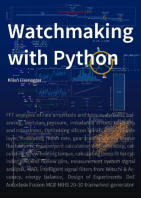
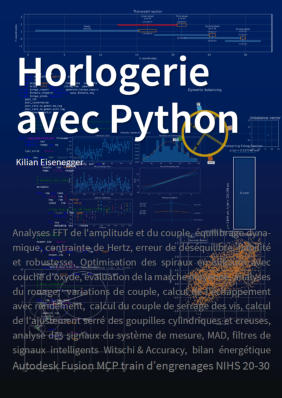
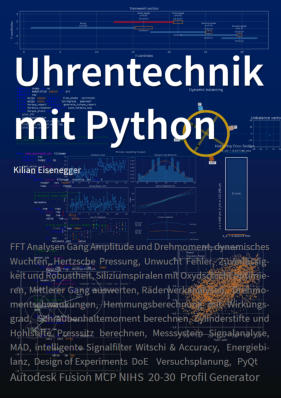
Mechanical watchmaking has evolved far beyond traditional design methods. Today, numerical simulation, data analysis and software engineering have become essential tools in the development of high-performance mechanical movements. Python for Watchmaking bridges the gap between classical horology and modern engineering. Using practical Python examples, the book demonstrates how physical principles can be modelled, analysed and optimised with professional software tools. The book is available in English, German and French, making it accessible to readers throughout the international watchmaking industry.What You Will Learn
The book covers a wide range of engineering topics, including: • Python programming for engineering applications • Mechanical watch theory • Gear trains and escapements • FFT analysis of timing variations • Dynamic balancing • Hertzian contact pressure • Signal processing and data analysis • Design of Experiments (DOE) • Monte Carlo simulation • Reliability and Weibull analysis • Silicon hairsprings • Numerical optimisation • Modern graphical user interfaces with PyQt • Automatic report generation • Engineering software architecture Each topic is explained from first principles and illustrated with complete Python programs that readers can study, modify and extend.Practical Engineering
Rather than focusing on programming alone, the book presents real engineering problems taken from modern watch development. Readers learn how physical models are transformed into practical simulation tools, how experimental data can be analysed and how engineering decisions can be suppor- ted using numerical methods. The emphasis is always on understanding the underlying physics as well as implementing efficient and maintainable software.Who Should Read This Book?
This book is intended for: • Watchmakers • Mechanical engineers • Movement designers • Students • Python developers interested in engineering • Anyone wishing to combine classical horology with modern computational methods No advanced programming experience is required. Python concepts are introduced progressively throughout the book, allowing readers to build their knowledge step by step.
watchmaking.com, Kilian Eisenegger, (C) 2026 info@watchmaking.com, HTML5 Standards, performance is our profession, visit us on facebook
Available Editions
The book is available as: • Printed Book at amazon.de, lehmanns.de, ebubli.com • PDF E-Book • Source Code Package All editions are available in English, German and French. The printed book is in black and white (grayscale), while the e-book is in colour.Companion Software
The book is accompanied by a growing collection of open-source Python projects, demonstrating many of the engineering methods presented throughout the chapters. These projects include simulation tools, engineering libraries and practical applications for modern watchmaking. The complete collection is available on GitHubWatchmaking
Watchmaking is one of the most fascinating engineering disciplines there is. It combines precision, physics, materials science, and centuries-old craftsmanship into a single sys-tem that delivers peak performance within the smallest of spaces. But while classical watchmaking long relied on experience, intuition, and traditional knowledge, today’s world opens entirely new possibilities: the combination of traditional mechanics with modern numerical simulation. This book pursues a clear goal: it aims not only to show you how to calculate, but above all why. Every formula, every script, and every simulation is a tool for understand- ing the physics behind the watch. You will learn to question assumptions, critically evaluate models, and develop your own solutions. A central component of this approach is Design of Experiments (DOE). Whereas in the past individual parameters were changed in isolation, DOE allows for a systematic investigation of multiple influencing factors simultaneously. Especially in watchmaking, where many effects are interlinked, this enables a deeper understanding. Interac- tions between geometry, material, and manufacturing become visible and can be specifically leveraged. Building on this foundation, we take a decisive step further: from analysis to optimization. With the help of response models and desirability functions, target variables such as running time, force curves, or efficiency can not only be calculated but also specifically adjusted. This reveals an important insight: the maximum value of a variable is rarely the optimum. Only the definition of a target state and the simultaneous consideration of multiple requirements lead to a technically sound solution. A particularly illustrative example of this is the analysis of systems with multiple responses, such as the lever of a minute-tracker. Here, forces must be balanced in two directions of motion simultaneously. Such problems can only be solved through a combined analysis and optimization of multiple target variables—a classic application of modern DOE methods. Another focus is on practical relevance. The Python scripts presented are not intended as abstract examples, but as genuine design tools. They enable the targeted design of components, the analysis of tolerances, and the evaluation of a caliber’s performance. In doing so, we operate at the intersection of education and industrial applica- tion. At the same time, this book is meant to inspire: to inspire you to explore new paths, to question existing methods, and to further develop watchmaking technology. For the future of this field lies precisely in this connection in the interplay of traditional understanding, systematic experimental design, and modern simulation.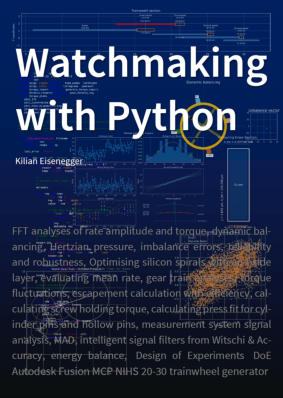
Order Your Personalized E-Book – 78 CHF
Purchase your digital copy safely and conveniently via PayPal. You can also place an order using your credit card.
After completing your order, you will receive a personalized, watermarked e-book by email within just a few hours.
Choose your E-Book language edition:


watchmaking
Technical knowledge of watch construction, mechanical watches,
complications, VBA programmes, books, watch technologyr


Python for Watchmaking
Modern Engineering for Mechanical Watches
Mechanical watchmaking has evolved far beyond traditional design methods. Today, numerical simulation, data analysis and software engineering have become essential tools in the development of high-performance mechanical movements. Python for Watchmaking bridges the gap between classical horology and modern engineering. Using practical Python examples, the book demonstrates how physical principles can be modelled, analysed and optimised with professional software tools. The book is available in English, German and French, making it accessible to readers throughout the international watchmaking industry.What You Will Learn
The book covers a wide range of engineering topics, including: • Python programming for engineering applications • Mechanical watch theory • Gear trains and escapements • FFT analysis of timing variations • Dynamic balancing • Hertzian contact pressure • Signal processing and data analysis • Design of Experiments (DOE) • Monte Carlo simulation • Reliability and Weibull analysis • Silicon hairsprings • Numerical optimisation • Modern graphical user interfaces with PyQt • Automatic report generation • Engineering software architecture Each topic is explained from first principles and illustrated with complete Python programs that readers can study, modify and extend.Practical Engineering
Rather than focusing on programming alone, the book presents real engineering problems taken from modern watch development. Readers learn how physical models are transformed into prac- tical simulation tools, how experimental data can be analysed and how engineering decisions can be supported using numerical methods. The emphasis is always on understanding the underlying phys- ics as well as implementing efficient and maintainable software.Who Should Read This Book?
This book is intended for: • Watchmakers • Mechanical engineers • Movement designers • Students • Python developers interested in engineering • Anyone wishing to combine classical horology with modern computational methods No advanced programming experience is required. Python concepts are introduced progressively throughout the book, allowing readers to build their knowledge step by step.
Please order the Book on the Desktop Webpage
All editions are available in English, German and French.